

-

Way to Wealth
Way to Wealth is a series of essays written by Benjamin Franklin. One of the most powerful guides ever written in the history of economics, quotes in this centuries old book still holds true even after 300 years.
While we all wanted to get rich and looking for shortcuts to attain wealth, we miss out small things, which are ought to be followed in our life. For example the famous quote “One Today is worth two tomorrows”, not only makes us to follow the habit of saving, but not to follow the habit of borrowing, means we have to pay double in future for what we borrow today.
There is nothing can be gained without pain, if you gain something without pain, it is sooner or later going to disappear from you. Many of us do not know the difference between time spent and time lost. There is no such thing as idle time, there is only leisure time which we spend to recharge us from day to day activity, rather not to waste time. While it is 100 percent true that time is the only thing we cannot earn. The act of procrastination is clearly stated with the quote “Have you somewhat to do tomorrow, do it today”. The act of ignoring small gains and not bothering to keep them is quoted as “Get what you can, and what you get hold”
-
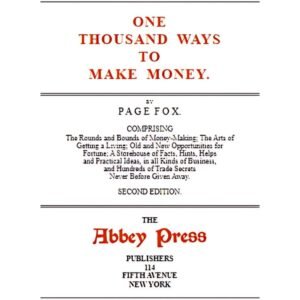
One Thousand Ways to Make Money
One Thousand Ways to Make Money is a self-help and business success book written by Page Fox, an author of books on personal success.
The object of this work is to help people who are out of employment to secure a situation; to enable persons of small means to engage in business and become their own employers; to give men and women in various lines of enterprise ideas whereby they may succeed; and to suggest new roads to fortune by the employment of capital. The author has been moved to the undertaking by the reflection that there exists nowhere a book of similar character.
There have indeed been published a multitude of books which profess to tell men how to succeed, but they all consist of merely professional counsel expressed in general terms. We are told that the secrets of success are “industry and accuracy,” “the grasping of every opportunity,” “being wide awake,” “getting up early and sitting up late,” and other cheap sayings quite as well known to the taker as to the giver. Even men who have made their mark, when they come to treat of their career in writing, seem unable to give any concrete suggestions which will prove helpful to other struggling thousands, but simply tell us they won by “hard work,” or by “close attention to business.”
-
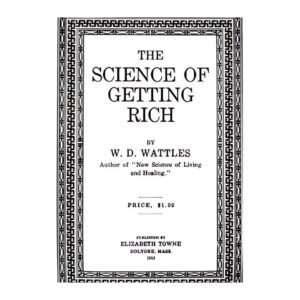
The Science of Getting Rich
The Science of Getting Rich is a self-help book written by American new thought writer Wallace D. Wattles, one of the widely quoted author whose other works include The Science of Being Well, The Science of Being Great, and How to Get What You Want.
This book is pragmatical, not philosophical; a practical manual, not a treatise upon theories. It is intended for the men and women whose most pressing need is for money; who wish to get rich first, and philosophize afterward. It is for those who have, so far, found neither the time, the means, nor the opportunity to go deeply into the study of metaphysics, but who want results and who are willing to take the conclusions of science as a basis for action, without going into all the processes by which those conclusions were reached.
-
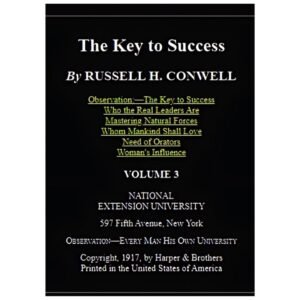
The Key to Success
The Key to Success is a leadership development guide written by American motivational writer Russell H. Conwell, who founded the Temple University.
People are thinking, but they can think much more. The housewife is thinking about the chemical changes caused by heat in meats, vegetables, and liquids. The sailor thinks about the gold in sea-water, the soldier thinks of smokeless powder and muffled guns; the puddler meditates on iron squeezers and electric furnaces; the farmer admires Luther Burbank’s magical combinations in plant life; the school-girl examines the composition of her pencil and analyses the writing-paper; the teacher studies psychology at first hand; the preacher understands more of the life that now is; the merchant and manufacturer give more attention to the demand. Yes, we are all thinking. But we are still thinking too far away; even the prism through which we see the stars is near the eyes. The dentist is thinking too much about other people’s teeth.
This book is sent out to induce people to look at their own eyes, to pick up the gold in their laps, to study anatomy under the tutorship of their own hearts. One could accumulate great wisdom and secure fortunes by studying his own finger-nails. This lesson seems the very easiest to learn, and for that reason is the most difficult.
-

Girl Moments Coloring Book!
Girl Moments Coloring Book!


