
-
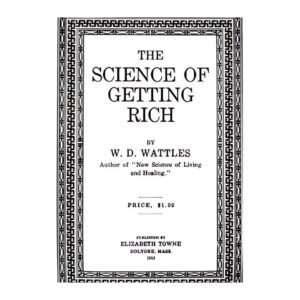
The Science of Getting Rich
The Science of Getting Rich is a self-help book written by American new thought writer Wallace D. Wattles, one of the widely quoted author whose other works include The Science of Being Well, The Science of Being Great, and How to Get What You Want.
This book is pragmatical, not philosophical; a practical manual, not a treatise upon theories. It is intended for the men and women whose most pressing need is for money; who wish to get rich first, and philosophize afterward. It is for those who have, so far, found neither the time, the means, nor the opportunity to go deeply into the study of metaphysics, but who want results and who are willing to take the conclusions of science as a basis for action, without going into all the processes by which those conclusions were reached.
-
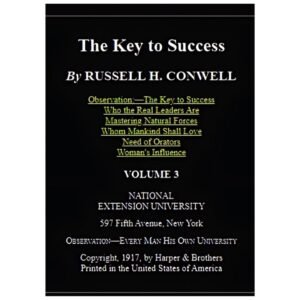
The Key to Success
The Key to Success is a leadership development guide written by American motivational writer Russell H. Conwell, who founded the Temple University.
People are thinking, but they can think much more. The housewife is thinking about the chemical changes caused by heat in meats, vegetables, and liquids. The sailor thinks about the gold in sea-water, the soldier thinks of smokeless powder and muffled guns; the puddler meditates on iron squeezers and electric furnaces; the farmer admires Luther Burbank’s magical combinations in plant life; the school-girl examines the composition of her pencil and analyses the writing-paper; the teacher studies psychology at first hand; the preacher understands more of the life that now is; the merchant and manufacturer give more attention to the demand. Yes, we are all thinking. But we are still thinking too far away; even the prism through which we see the stars is near the eyes. The dentist is thinking too much about other people’s teeth.
This book is sent out to induce people to look at their own eyes, to pick up the gold in their laps, to study anatomy under the tutorship of their own hearts. One could accumulate great wisdom and secure fortunes by studying his own finger-nails. This lesson seems the very easiest to learn, and for that reason is the most difficult.
-
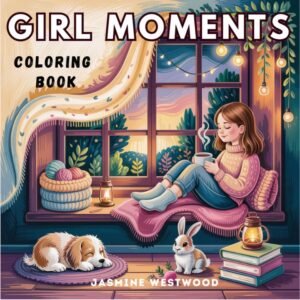
Girl Moments Coloring Book!
Girl Moments Coloring Book!
-


Cozy Girl Season: A Cozy & Cute Bold and Easy Coloring Book for Adults
en & Teens, A Perfect Gift Festive … Festive Christmas Scenes for Mindful Joy.
Product details
- ASIN : B0FYPTPB8C
- Publisher : Independently published
- Publication date : October 31, 2025
- Language : English
- Print length : 120 pages
- ISBN-13 : 979-8272368652
- Item Weight : 10.6 ounces
- Dimensions : 8.5 x 0.28 x 8.5 inch
-

Swear Words Coloring Book for Adults
Product details
- ASIN : B0F6V1XRWF
- Publisher : Ignited Minds Edutech , JASMINE WESTWOOD
- Publication date : April 26, 2025
- Language : English
- Print length : 127 pages
- ISBN-10 : 8198694544
- ISBN-13 : 978-8198694546
- Item Weight : 13.9 ounces
- Dimensions : 8.5 x 0.29 x 11 inches


